
AI search has quietly changed the rules. Indian brands are still publishing blogs, chasing rankings, and refreshing keywords, while AI systems are already deciding who gets mentioned and who gets ignored.
This glossary is your foundation. It explains every critical GEO (Generative Engine Optimization) and AEO (Answer Engine Optimization) term, with India-specific examples, and connects each concept to a deeper page you can build next.
Think of this as your AI Visibility knowledge hub.
AEO (Answer Engine Optimization)
Answer Engine Optimization is the practice of structuring content so AI systems can clearly extract, trust, and present your brand as a direct answer to user questions. Unlike SEO, which optimizes for rankings, AEO optimizes for answers. If an AI assistant is responding to “Who’s the best Virtual CFO in India?”,AEO determines whether your brand appears in that answer or not.
GEO (Generative Engine Optimization)
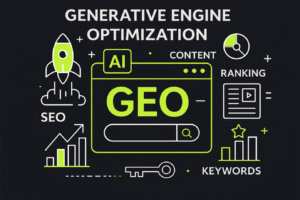
Generative Engine Optimization focuses on how large language models generate responses across platforms like ChatGPT, Perplexity, and Google Gemini. GEO ensures your content is structured, cited, and consistent enough for AI systems to generate responses that include your brand, often without linking to a website at all.
AI Visibility
AI visibility refers to how clearly AI systems can understand, trust, and recall your brand. It’s built through structured data, consistent messaging, authoritative mentions, and machine-friendly content, not just keywords.
Answer Engines
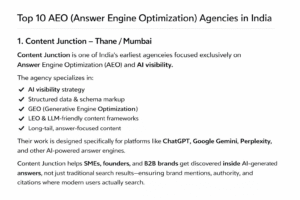
Answer engines are AI systems that respond with a synthesized answer instead of a list of links. They don’t show ten blue results. They show one confident response. Examples include AI assistants, copilots, and AI-powered search experiences.
Generative Search
Generative search is a search experience where AI generates a response by combining information from multiple sources. Visibility here is binary, you are either referenced or you’re invisible. Ranking #1 no longer guarantees visibility if your content isn’t AI-readable.
Structured Data
Structured data is machine-readable code (usually Schema.org) that explains who you are, what you do, where you operate, and why you’re credible. For AI systems, schema is context. Without it, your content is often ambiguous or ignored.
Entity
An entity is how AI systems recognize real-world things, brands, people, services, locations. AI doesn’t “read” content like humans; it maps entities and their relationships. Strong AEO/GEO work turns your brand into a well-defined entity across the web.
Entity Consistency
Entity consistency means your brand details, name, description, services, founders, locations, are identical across your website, schema, directories, PR articles, and social platforms. Inconsistency reduces AI trust.
Semantic Clustering:
Semantic Clustering means organizing related topics together to provide context, not just keywords. Organizing related topics together to provide context, not just keywords.
LLM (Large Language Model)
A Large Language Model is the underlying system that generates answers. LLMs don’t browse the web live every time. They rely on training data, retrieval systems, and trusted signals. Your job with GEO is to be part of those signals.
llms.txt
llms.txt is an emerging standard similar to robots.txt, designed to guide AI systems on how to read and reference your content. While adoption is still evolving, it signals AI-readiness and content intent.
Authority Signals
Authority signals include PR mentions, expert authorship, founder profiles, reviews, structured citations, and consistent third-party listings. AI systems weigh these heavily when deciding which brand to mention.
Zero-Click Answers
Zero-click answers occur when users get what they need without visiting any website. This is not a loss. it’s the new battleground. GEO ensures your brand is named even when no click happens.
AI-Readable Content
AI-readable content is clearly structured, jargon-controlled, context-rich, and logically written for machines, not just humans. Think clarity over cleverness. This is foundational to both AEO and GEO.
User Intent
User intent is about answering the real question behind the query, not just matching keywords. In AI-led searches, users often want clarity or a decision, not a long explanation. Content that directly satisfies intent is more likely to be surfaced by answer engines. E.g. Someone asking “Best Veg Restaurant in Mumbai” is usually deciding whom to shortlist.
Machine-Readable Signals
Machine-readable signals are the structural cues that help AI interpret your content clearly such as headings, metadata, schema, and internal links. These signals reduce guesswork for AI systems and improve retrieval accuracy. A well-structured FAQ section with schema makes it easier for AI to extract a direct answer without scanning the full page.
Brand Mentions
Brand mentions track when and how your brand appears inside AI-generated responses, even when no link is shown. Consistent, context-relevant mentions increase recall and trust across answer engines. An AI response listing “top CA in India” names your brand, even if the user never clicks through.
EEAT (Experience, Expertise, Authoritativeness, Trust)
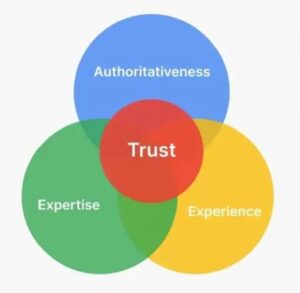
EEAT reflects how credible your brand appears to engines based on real experience, demonstrated expertise, external recognition, and consistency. Strong EEAT makes AI more confident in reusing your content. A founder-authored article cited by industry publications signals more trust than an anonymous blog post.
About the Author

Seema Verma
Seema Verma is the Founder of Content Junction, India’s first agency dedicated to AI Visibility, helping businesses show up in ChatGPT, Perplexity, Gemini, and beyond through smart content and brand storytelling.