
For more than two decades, traditional SEO shaped visibility on the internet. If you ranked, you were seen. If you were seen, you were trusted. And if you were trusted, you won. But 2025 and 2026 created a shift that even SEO veterans didn’t expect. Users moved from typing keywords to asking questions. AI assistants began summarizing information before anyone clicked a link. And suddenly, the battle for brand visibility moved from the SERP to the answer box.
Here’s the truth marketers are finally admitting. Traditional SEO still matters, but it no longer guarantees brand visibility. We’ve entered a world where AI SEO, powered by AEO (Answer Engine Optimization), determines whether your content appears inside AI-generated answers. In other words, SEO helps people find your content. AEO helps machines choose your content. And in an AI-first landscape, that choice is everything.
Let’s break down how AEO and SEO work, how they differ, and why the strongest brands in 2026 will use both as a unified visibility strategy.
What Is AEO?
AEO, or Answer Engine Optimization, is the practice of structuring content so AI assistants can retrieve, summarize, and cite it accurately. It responds to a new reality where users no longer sift through pages of blue links. They ask conversational questions, expect a single clear answer, and treat AI tools like ChatGPT, Gemini, and Perplexity the way they once treated Google.
AEO exists because modern search behavior looks nothing like 2015 or even 2020. People speak queries instead of typing them. Zero-click results now exceed 65%. Voice search is at over a billion monthly queries. AI Overviews summarize content before SERPs even appear. And in this environment, brands can’t rely on long paragraphs and keyword density. They need structured clarity.
That means using short answer blocks, explicit entities, schema markup, and modular paragraphs that AI models can lift directly. AEO favors precision. It rewards clarity. And it gives your content a higher chance of showing up inside the answer, not just near it.
If SEO makes your content findable, AEO makes your content quotable.
What Is Traditional SEO?
Traditional SEO is the foundational practice of optimizing websites to rank on search engines like Google and Bing. It focuses on improving organic visibility through keyword targeting, technical health, backlinks, site speed, and content depth. SEO helps brands build authority, attract traffic, and support every stage of the marketing funnel.
And despite dramatic changes in search, SEO is far from obsolete. Google still processes more than 8 billion queries a day. The SERP still houses deep research intent. People still rely on organic results for complex decisions. And fundamentally, AI SEO still depends on strong traditional SEO, because AI models lean heavily on authoritative, high-ranking domains when selecting sources.
The limitation is that SEO was built for exploration, scrolling, skimming, and clicking. Today’s AI-driven searches favor extraction pulling short, precise, structured information that can be dropped directly into an answer.
That’s where AEO extends the work SEO starts.
SEO builds your library.
AEO tells the librarian what to read aloud.
What Are the Key Differences Between AEO and SEO?
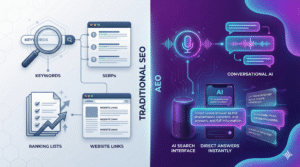
- AEO and SEO often look similar from the outside, but they operate on different search surfaces.
- SEO optimizes for traditional results pages. AEO optimizes for conversational interfaces, AI summaries, and voice outputs. SEO prioritizes long-form depth and keyword alignment. AEO prioritizes structure, entities, schema, and concise explanations.
- SEO measures rankings, traffic, and CTR. AEO measures citations, answer inclusion, source diversity, and brand visibility inside summaries.
- Most importantly, SEO serves users who explore. AEO serves users who ask.
This is why AEO is not a competitor to SEO. It’s the evolution of SEO, the structural layer that prepares your content for a machine interpreting your expertise, not just a human reading it.
AEO and SEO Trends in 2026
The next year will reshape search even more aggressively. AI Overviews are rapidly becoming the default Google experience. Perplexity is growing month over month. ChatGPT’s search usage continues to explode. Meanwhile, users show a strong preference for conversational, context-rich answers over browsing multiple pages.
AI visibility is becoming a brand’s first impression. Schema and structured data are no longer optional. Entities and clarity matter more than keyword density. Freshness is weighted more heavily because outdated content can create model hallucinations. And brand mentions outside your own website—Reddit threads, expert reviews, and third-party citations now influence whether AI models treat you as a trustworthy source.
In short, brands can no longer win visibility simply by ranking. They must become extractable.
AEO vs. SEO: Key Takeaways
AEO isn’t a trend. It’s the natural evolution of SEO in an AI-dominated search landscape. Here’s what every marketer needs to internalize now.
Treat AEO as the next chapter of SEO, not a replacement. SEO still establishes authority, but AEO transforms that authority into citations inside AI-generated answers. Your goal isn’t just to rank. It’s to be included.
Structure everything for extraction. AI assistants cite answers they can lift cleanly, so your content must be modular, scannable, and built in 40–90 word blocks that stand alone.
Earn mentions beyond your own domain. LLMs rely heavily on cross-web credibility. Reddit discussions, expert opinions, datasets, and third-party reviews heavily influence who gets cited.
Instrument AI visibility. GA4 and GSC cannot measure citations, AI mentions, or answer placement. You need tools built for the new search surfaces if you want a complete visibility picture.
Prepare for agentic execution. AI agents increasingly complete tasks, not just provide answers. Brands that expose structured APIs, clean documentation, and LLMs.txt files will have a strategic advantage.
Freshness is becoming non-negotiable. AI models aggressively penalize outdated pages. Frequent updates signal trust, safety, and relevance.
Machine-readable clarity beats keyword density. AI SEO is about helping models understand your content, not stuffing it with keywords.
Mastering AEO today ensures your brand appears not only in the search results, but in the answer, and eventually in the actions, that shape every customer’s journey.
How to Monitor AEO and SEO
Monitoring AEO (Answer Engine Optimization) and SEO together requires two different measurement stacks. Traditional SEO tracking uses Google Search Console, Google Analytics 4, Site Audits, keyword ranking tools, and conversion analysis. These metrics show how your pages perform inside SERPs, but they tell you nothing about your AI visibility.
AEO tracking focuses on entirely new signals. You track where your brand appears inside AI-generated responses. You analyze citations and narrative drivers across ChatGPT, Gemini, Perplexity, and AI Overviews. You watch how models reference your brand, how often they include your domain, and what prompts trigger your inclusion. You examine sentiment and safety signals, because AI models deprioritize contentious or outdated information. And you monitor your presence across non-Google sources like Reddit, YouTube, industry forums, and review sites, because AI heavily weights these ecosystems.
If you’re only measuring SEO, you’re missing half your visibility. And in 2026, that half will be the half users see first.
FAQs on AEO vs SEO
Can AEO and SEO work together?
Yes. SEO establishes authority and relevance. AEO helps that authority surface inside AI answers. The two strategies support each other and should never be separated.
Is AEO replacing SEO?
No. AEO depends on strong SEO fundamentals. Without a trusted domain, your content is unlikely to be cited by AI assistants.
Which one should I prioritize?
Start with SEO. Without strong technical health and authority, AEO won’t take you far. Once SEO is stable, layer in AEO to expand your AI visibility.
Can one page be optimized for both?
Yes. In fact, the best pages use long-form depth for SEO and structured answer blocks for AEO.
Why do AI assistants cite some brands more than others?
AI models prefer brands with entity clarity, structured data, fresh content, strong topical authority, and consistent mentions across the web.
How does AEO improve brand visibility?
AEO increases your presence inside AI summaries, voice answers, and conversational queries, surfaces where attention is growing faster than traditional SERPs.
How do I monitor AEO?
You track citations, inclusion rates, narrative drivers, sentiment signals, and AI Overview visibility. SEO analytics alone can’t measure this.
Final Takeaway: The Future Belongs to Brands That Structure Their Thinking
Traditional SEO still drives discovery. AEO drives inclusion. And in a world where AI answers appear before organic results, inclusion is becoming the new battleground for brand visibility.
Your goal is not just to rank. Your goal is to be used. To be cited. To be trusted by machines and humans simultaneously. The brands that structure their content for extraction clean, modular, factual, and machine-friendly will control visibility across every AI interface.
AI SEO is no longer a niche tactic. It is the operating system for modern content marketing services. And the brands that adapt first will own the next decade of visibility.
About the Author

Seema Verma
Seema Verma is the Founder of Content Junction, India’s first agency dedicated to AI Visibility, helping businesses show up in ChatGPT, Perplexity, Gemini, and beyond through smart content and brand storytelling.