
Most brands think AEO tools are just “SEO tools with AI slapped on.” That belief is why they’re invisible inside AI assistants like ChatGPT, Gemini, and Perplexity.
As AI assistants replace traditional search journeys, Answer Engine Optimization is no longer optional. But not all AEO tools are built for how AI actually selects answers. Some help. Many distract. A few genuinely compound visibility.
This is the complete guide most people skip.
How do AI answer engines actually decide who shows up?
This is where people get it wrong. AI visibility is not rankings. It’s selection. Models don’t scroll. They choose.
Here’s what consistently influences that choice.
Content quality and depth
AI engines reward content that fully resolves a question, not content that teases it. That means clear explanations, complete frameworks, definitions, examples, and logical flow. Thin content doesn’t get “partially rewarded.” It gets ignored.
Insight, not volume, wins.
Credibility and trust signals
LLMs don’t “trust vibes.” They rely on signals. Mentions from authoritative publishers, references to credible data, associations with known institutions, awards, certifications, and expert attribution all matter.
Authority is cumulative. You borrow it before you own it.
Intent alignment and relevance
AI doesn’t ask “Is this keyword present?” It asks “Does this answer the question being asked right now?” Content must be built around answer intent, not traffic intent.
Most content is optimized for clicks. AI optimizes for closure.
Citations and external mentions
If your brand is never referenced by others, AI has no reason to reference you. Citations from industry publications, research hubs, Wikipedia-style sources, and trusted media dramatically increase selection likelihood.
You don’t rank your way into answers. You get cited into them.
Topical authority and focus
Generalists lose. Specialists get chosen. AI prefers brands that demonstrate consistent depth within a defined domain. One strong topic cluster beats ten scattered blogs.
Focus creates familiarity. Familiarity drives selection.
And that’s just the surface. AI visibility is shaped by many more structural and contextual factors, but these form the foundation.
Now let’s talk tools.
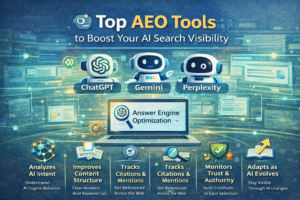
What should you actually look for in an AEO tool?
Most brands buy tools that help them produce. Very few invest in tools that help them structure.
That difference matters.
1) Does the tool understand AI behavior, not just generate content?
Good AEO tools analyze question patterns, follow-up intent, and conversational depth. They help you map how users ask, refine, and escalate questions across AI chats.
Bad tools just rewrite blogs faster.
2) Can it optimize content for answer selection, not SERP rankings?
AI engines prioritize clarity, specificity, and structured answers. Tools should help you format content into definitions, steps, comparisons, and explanations that LLMs can parse and reuse.
If it only talks about keywords, it’s behind.
3) Does it guide structure, not just suggestions?
AI loves predictable structure. Clear headings. Direct answers. Logical progression. Tools that recommend how to organize content outperform tools that only suggest what to add.
Structure is the new optimization layer.
4) How well does it handle credibility signals?
The strongest tools don’t just analyze your site. They track mentions, citation sources, and authority gaps across the ecosystem. They help you understand where trust is missing and how to earn it.
Visibility is ecosystem-wide, not page-level.
5) Is it built to evolve with AI search changes?
AI platforms change fast. Tools must update faster. If updates are rare or unclear, you’re optimizing for yesterday’s model behavior.
Static tools don’t survive dynamic systems.
5) Is it usable by strategists, not just operators?
The best AEO tools support decision-making. They show why something works, not just what to change. Ease of use matters because adoption speed equals learning speed.
If your team avoids the tool, the tool fails.
Let’s be real. Brands don’t need more AI-written content. They need AI-readable thinking.
AEO is not about gaming models. It’s about teaching them who you are, what you know, and why you’re worth quoting.
The brands that win in AI search won’t chase every tool. They’ll choose the ones that help them build clarity, credibility, and consistency. That’s the real optimization layer. And that’s where most teams are still blind.
About the Author

Seema Verma
Seema Verma is the Founder of Content Junction, India’s first agency dedicated to AI Visibility, helping businesses show up in ChatGPT, Perplexity, Gemini, and beyond through smart content and brand storytelling.