
A clear definition of Generative Engine Optimization (GEO)
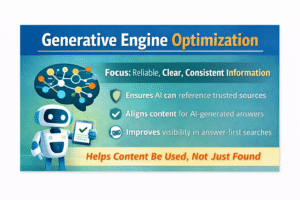
Generative Engine Optimization (GEO) is the practice of structuring and presenting information so that it can be reliably selected, interpreted, and reused by generative AI systems when they produce answers. Unlike traditional search optimization, which focuses on ranking web pages in search results, GEO focuses on whether a source is clear, consistent, and trustworthy enough to be included directly inside AI-generated responses. GEO matters in environments where users receive synthesized answers rather than lists of links, such as AI assistants and answer-first search interfaces, where visibility depends on being cited, referenced, or implicitly relied upon by the model.
Why Generative Engine Optimization exists
The way people look for information has changed quietly but fundamentally. Instead of browsing multiple links, users now ask direct questions and expect a single, confident answer. In these moments, AI systems do not display the web; they compress it. They decide which explanations are safe to reuse, which sources feel authoritative, and which ideas can be presented without hesitation.
Generative Engine Optimization exists because visibility no longer depends only on being discoverable. It depends on being usable. A page can be indexed, crawlable, and even well-ranked, yet still be ignored by generative systems if its message is unclear or inconsistent. GEO addresses this gap by focusing on how information is selected and reused, not just how it is found.
How generative engines decide what to use
Generative engines work by retrieving information from multiple sources and synthesizing it into a single response. In that process, not all sources are treated equally. Some are read once and discarded. Others are reused repeatedly across different answers.
What distinguishes reusable sources is not size, traffic, or brand recognition. It is clarity. Generative systems favor sources that explain concepts cleanly, define terms without ambiguity, and remain consistent across contexts. They are cautious by design. If a source feels vague, overly promotional, or contradictory, it is less likely to be reused, regardless of how visible it is in traditional search.
In practice, this means that being selected by a generative engine is closer to being trusted as a reference than being rewarded for optimization effort.
GEO vs SEO vs AEO
Search Engine Optimization (SEO) focuses on improving a page’s visibility in ranked search results. It helps content get discovered when users search for information.
Answer Engine Optimization (AEO) focuses on structuring content so it can directly answer specific questions, often within featured snippets or voice responses.
Generative Engine Optimization (GEO) focuses on whether content can be safely incorporated into AI-generated answers. It is less concerned with where a page appears and more concerned with how reliably its information can be reused.
These approaches are not substitutes for one another. SEO supports discovery, AEO improves answer clarity, and GEO influences which sources shape generated explanations. In AI-first environments, all three can coexist, but GEO addresses a distinct layer of visibility.
What generative engines look for in sources
Generative engines tend to favor sources that behave more like reference material than marketing assets. Several high-level signals consistently matter.
First, the source must have clear identity and scope. It should be obvious what the content is about and who it is intended for. Second, depth matters more than breadth. A focused explanation of a topic is easier to trust than a surface-level overview of many ideas. Third, structure plays a role. Content that is logically organized and internally consistent is easier for models to interpret and reuse. Finally, consistency across the web reinforces trust. When the same explanation appears without contradiction across multiple contexts, confidence increases.
These signals are evaluated implicitly. They are not checklists, but patterns that accumulate over time.
Content formats that perform well in generative environments
Certain types of content tend to perform better because they align with how generative systems reuse information. Clear definitions work well because they can be quoted without surrounding context. Frequently asked questions perform well when they mirror how people naturally ask questions. Comparisons are useful when they explain differences without exaggeration. Expert explanations tend to surface when they are written to clarify rather than persuade.
What these formats have in common is restraint. They priorities explanation over optimization and clarity over creativity.
Where GEO shows up in practice
GEO becomes visible wherever AI systems are expected to explain, summaries, or guide decisions. This includes AI assistants responding to user questions, answer-first search experiences that generate summaries instead of lists, and research or decision-support tools that synthesis information across sources.
In all of these cases, users may never see the original page. Yet the page still shapes the answer. GEO operates in this invisible layer, influencing outcomes without requiring a click.
Small brands can be cited in AI assistants
One of the most common misconceptions about generative visibility is that only large or highly ranked brands are selected by AI systems. In practice, this is not true.
A small brand, even one that appears on page nine or ten of traditional search results, can still be cited or relied upon by a generative engine if its content meets the right conditions. For example, a niche company with a single, well-structured explanation of a concept, written clearly and repeated consistently across its presence, may be selected over a larger competitor whose content is vague or heavily promotional. Generative engines do not reward popularity alone. They reward interpretability and confidence.
This is why GEO is fundamentally different from ranking-based visibility. It allows smaller, focused sources to participate in generated answers when they communicate with precision.
How GEO is measured
GEO is not measured primarily through clicks or traffic. Its signals are quieter. Inclusion in AI-generated answers, repeated reference to the same source for the same concept, and consistent alignment between a brand and a topic all indicate GEO effectiveness.
A source may influence hundreds of decisions without generating noticeable traffic. From a generative perspective, visibility is defined by contribution, not visits.
Common misunderstandings about GEO
GEO is often confused with prompt engineering, but prompts cannot compensate for unclear or untrusted sources. It is also mistaken for keyword optimisation for AI, even though generative systems do not interpret content the way crawlers do. Finally, GEO is sometimes framed as a replacement for SEO, when in reality it addresses a different stage of visibility. SEO helps content be found. GEO helps content be used.
Clarifying these distinctions is important because GEO is less about tactics and more about how information behaves in AI-driven environments.

Frequently asked questions about GEO
What is GEO in simple terms?
GEO is about making information clear and reliable enough that AI systems can reuse it when generating answers.
Is GEO the same as SEO?
No. GEO focuses on source selection inside generated answers, not on rankings or traffic.
Can small businesses benefit from GEO?
Yes. Smaller brands can be cited if their content is clear, focused, and consistent.
Does GEO work even without high search rankings?
Yes. Generative engines may cite sources that rank poorly if those sources explain a concept more clearly.
Does GEO replace SEO?
No. GEO and SEO address different layers of visibility and often work best together.
A closing note on Generative Engine Optimization
GEO is not a shortcut and not a trick. It reflects a shift in how information is selected and reused when answers are generated rather than retrieved. In these environments, visibility is no longer only about being found. It is about being understood.
Brands do not disappear because they are small. They disappear because they are unclear.
About the Author

Seema Verma
Seema Verma is the Founder of Content Junction, India’s first agency dedicated to AI Visibility, helping businesses show up in ChatGPT, Perplexity, Gemini, and beyond through smart content and brand storytelling.