For years, content marketing followed a predictable formula.
Publish blog posts.
Rank on Google.
Drive traffic.
Convert visitors.
But AI-driven search is starting to change that model.
Today, more users ask questions directly inside AI tools like ChatGPT, Perplexity, or Gemini. Instead of clicking multiple links, they receive synthesized answers generated from multiple sources across the web.
According to Gartner, generative AI interfaces could reduce traditional search engine traffic by 25% by 2026, reflecting a broader shift toward conversational AI as the primary interface for information discovery. This suggests that brands can no longer rely only on ranking in search results and must increasingly focus on creating content that AI systems cite when generating answers.
This shift doesn’t mean content is becoming less important.
It means the type of content that earns visibility is changing.
AI systems rely on sources that clearly explain concepts, structure knowledge effectively, or help users make decisions. Over time, a pattern has emerged around the types of content that consistently appear inside AI-generated answers.
Here are 10 content formats that are quietly becoming the foundation of AI visibility.
1. Thought Leadership Blog Content
AI systems increasingly reward demonstrated expertise.
Content written by practitioners, engineers, or specialists tends to carry more weight than generic marketing articles.
Signals like author credentials, real-world experience, and consistent subject-matter expertise help AI models determine whether content reflects genuine knowledge.
In many industries, articles written by experts are cited more often because they provide deeper insights than surface-level summaries.
2. Data-Backed Content and Original Research
Original research travels farther than almost any other content format.
When companies publish industry surveys, benchmark reports, or insights derived from internal product data, that information becomes reference material for the entire industry.
Many widely cited statistics in marketing today come from companies like Ahrefs or Semrush simply because they consistently publish proprietary datasets.
AI systems frequently pull from those same reports when summarizing industry trends.
Publishing original research positions a brand as a source of truth, increasing the likelihood of being cited.
3. Review and “Top 5” Lists
List-based articles that rank tools remain extremely influential.
Examples include:
Best tools for Ai visibility
Best AI writing platforms
According to research from Writesonic, review and ranking pages saw one of the largest increases in citations within generative AI answers, reinforcing the idea that AI models rely on curated product evaluations when suggesting solutions.
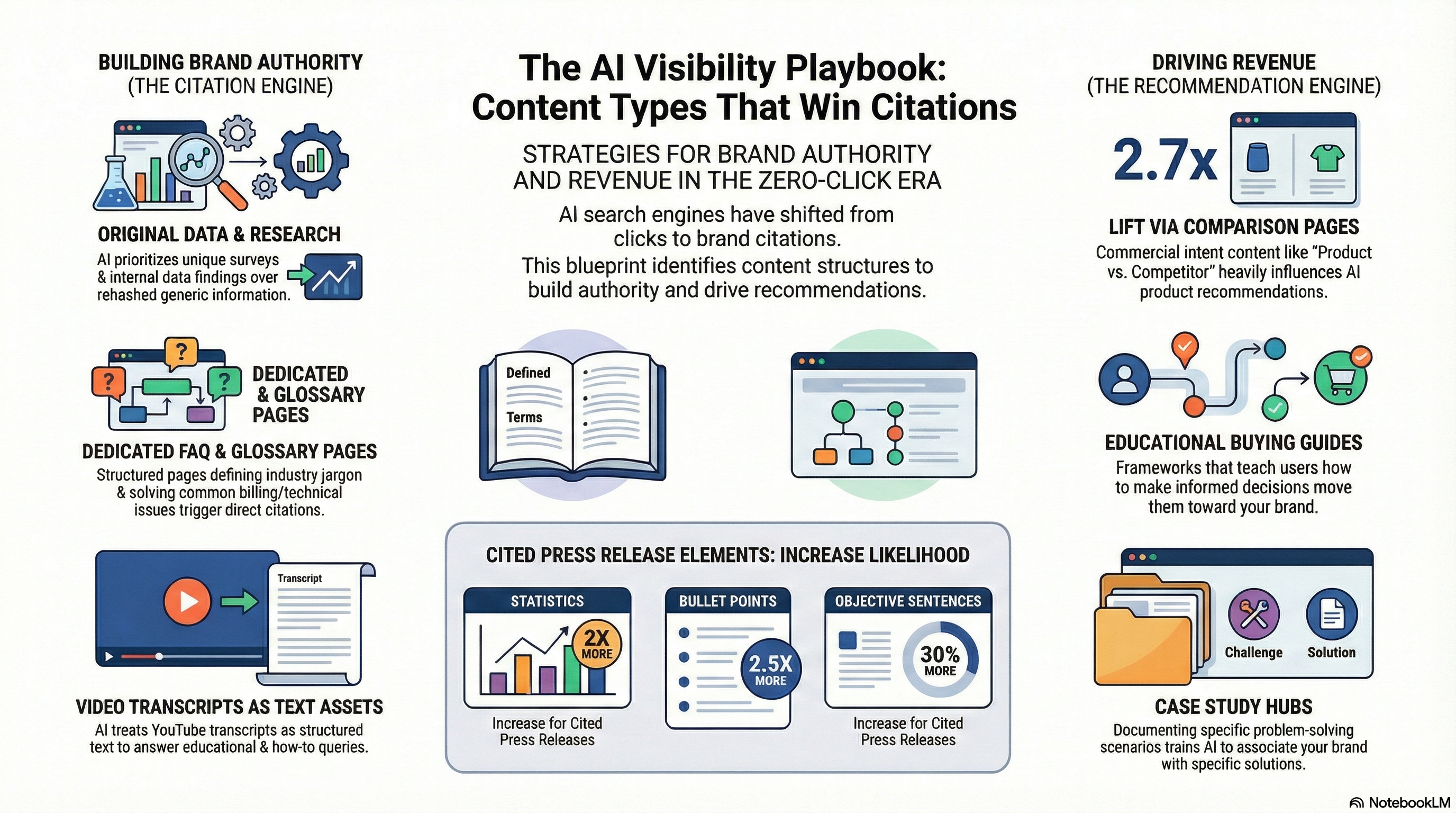
4. Educational Buying Guides
Buying guides help users understand how to evaluate solutions, not just which product to choose.
A strong buying guide explains things like:
- What product features matter most
- How pricing models differ
- Which tools work best for specific use cases
Because these guides teach decision frameworks, AI systems frequently rely on them when answering recommendation queries.
They provide the context needed to explain why certain tools fit specific requirements.
5. Structured Press Releases
Press releases are evolving beyond traditional PR announcements.
Modern releases often include:
- Bullet-point summaries
- Key statistics
- Structured explanations
- Short FAQ sections
These elements make it easier for AI systems to extract facts and summarize announcements.
As AI-driven discovery grows, well-structured press releases increasingly serve as reference sources.
6. Case Studies
Case studies demonstrate how products solve real problems.
Unlike product pages, they describe specific situations and outcomes.
A typical case study explains:
- The challenge faced by a customer
- The solution implemented
- The measurable results
This context helps AI systems connect products with real-world use cases.
When users ask how companies solve particular operational challenges, case studies often provide the examples AI systems reference when constructing answers
 7. Glossary and Terminology Pages
Glossary pages may look simple, but they perform extremely well in AI search. They define key industry terms in clear, concise language.
Examples include:
- What is Answer Engine Optimization (AEO)
- What is Ai visibility?
- What is Generative Engine Optimization (GEO)?
Definition:
A glossary page is a webpage that explains industry terminology in simple language so readers and AI systems can quickly understand a concept.
Analysis by Search Engine Land shows that AI answers frequently rely on sources that provide clear conceptual explanations, especially for educational queries. This indicates that generative search systems prioritize conceptual clarity and educational depth, not just traditional ranking signals like backlinks or domain authority.
8. Dedicated FAQ Pages
Many websites include a small FAQ section at the bottom of a page. But companies that frequently appear in AI answers often build dedicated FAQ pages, where each question becomes its own resource.
Think about the questions customers repeatedly ask:
- How does Ai visibility work?
- How can I get my brand cited on ChatGPT?
- Will I get cited if I write only content?
Publishing structured answers to these questions creates knowledge that AI systems can easily extract and reference.
When users ask similar questions inside AI tools, these pages often become the sources cited in the response.
9. YouTube Videos With Transcripts
Video content is becoming another important source of AI citations. AI systems don’t actually watch videos the way humans do. Instead, they analyze the text transcripts attached to those videos.
Those transcripts become structured text that AI models can interpret and reference.
Educational tutorials explaining workflows, tools, or technical processes often appear in AI answers because their transcripts contain clear step-by-step explanations.
10. Product Comparison Pages
Comparison pages answer one of the most common questions users ask:
“Which tool /product is better?”
These pages typically compare tools across criteria such as features, pricing, integrations, and usability.
Research from Write sonic found that comparison pages receive significantly higher citation rates in generative AI responses, highlighting how AI systems rely heavily on structured evaluation content when recommending products or software tools.
What This Means for AI Visibility
The rise of generative search is changing how brands should think about content.
Instead of publishing large volumes of generic blog posts, companies should focus on content that teaches, explains, and structures knowledge.
Pages that answer specific questions, define concepts, compare solutions, or present real-world outcomes are far more likely to be cited by AI systems than traditional marketing content.
Analysis by Search Engine Land suggests that generative search engines increasingly prioritize conceptual clarity and educational value, indicating that well-explained content may outperform high-authority domains that provide only surface-level information.
At Content Junction, we’ve seen this pattern repeatedly in AI visibility audits. The pages most frequently cited by AI systems are rarely generic blogs, they are structured knowledge assets such as guides, definitions, and decision frameworks.
In the AI search era, visibility isn’t just about ranking. It’s about becoming a source AI systems trust when constructing answers.
Key Takeaways
- According to Gartner, traditional search engine traffic could decline 25% by 2026, signaling a major shift toward AI-driven discovery.
- Analysis by Search Engine Land shows that AI answers prioritize sources that explain concepts clearly and provide educational depth.
- Research from Writesonic found that comparison pages and review content receive significantly higher citation rates in generative AI responses.
- Content formats such as FAQ pages, glossary definitions, buying guides, comparison pages, and case studies frequently appear in AI-generated answers.
FAQs
1. What types of content are most frequently cited by AI search engines?
Content that provides clear explanations, structured answers, and decision frameworks tends to appear most often in AI responses. AI systems prioritize sources that explain concepts clearly rather than relying solely on traditional search rankings.
2. What types of content are least likely to be cited by AI?
Content that is overly promotional, vague, or lacking clear explanations is less likely to be cited by AI systems. Articles that simply repeat generic advice without structured insights or supporting data often struggle to appear in AI-generated answers.
3. Why do comparison pages appear frequently in AI answers?
Comparison pages help AI systems evaluate products side by side. Research from Writesonic found that comparison pages receive significantly higher citation rates in generative AI responses when users ask questions like “Which tool is better?”
4. Why are glossary pages valuable for AI visibility?
Glossary pages define industry terminology in concise language, making them easy for AI systems to quote when answering educational queries.
5. What content structure is most likely to be cited by AI tools?
Structured knowledge content tends to perform best. Pages that combine clear headings, definitions, research insights, and direct answers are easier for AI systems to interpret and cite.
References
Gartner (2024)
Generative AI Will Reduce Traditional Search Engine Volume by 25% by 2026
https://www.gartner.com/en/newsroom/press-releases/2024-02-19-gartner-predicts-generative-ai-will-reduce-traditional-search-engine-volume
Analysis of generative AI search behavior and AI Overviews
https://searchengineland.com
https://writesonic.com/blog/generative-engine-optimization
About the Author

Seema Verma
Seema Verma is the Founder of Content Junction, India’s first agency dedicated to AI Visibility, helping businesses show up in ChatGPT, Perplexity, Gemini, and beyond through smart content and brand storytelling.