
The Search Revolution has begun. Most people think search is evolving.
It isn’t.
It’s being rewritten.
For nearly two decades, the internet followed a predictable loop. A user searched on Google, opened a few links, compared information across sources, and gradually made a decision. Every website was competing for a click, and every SEO strategy was built around earning that click.
That model is beginning to break.

Today, users increasingly receive direct answers instead of lists of links. AI-powered systems synthesize responses by pulling information from multiple sources and presenting it as a single, structured output. In many cases, that answer is sufficient, and the user never feels the need to explore further.
No tabs. No comparison. No browsing. Just one response.
This shift is subtle on the surface but significant underneath.
Search is no longer just a discovery mechanism. It is becoming a system that interprets and delivers decisions.
Earlier, Google functioned as a gateway. It surfaced options, users evaluated them, and websites controlled the experience. Now, AI systems sit between the user and the web. They interpret intent, filter sources, and present conclusions.
Which means the core question has changed.
It is no longer:
“How do I rank on Google?”
It is:
How do I become a source that AI systems choose?
There is also an uncomfortable reality embedded in this shift.
AI systems are trained on content published across the web, and then present synthesized versions of that content directly to users. As a result, users can derive value without visiting the original source.
Content still matters. Authority still matters. But the objective has shifted.
SEO is no longer just about ranking.
It is about being selected.
What Is AI Search?
AI search is often described as a conversational layer on top of traditional search engines.
That description is incomplete.
At its core, AI search represents a different architecture for connecting users to information. Instead of matching keywords to pages and ranking them, it attempts to understand the intent behind a query, retrieve relevant information, and generate a direct answer.
Most modern AI search systems operate using a two-layer approach. A retrieval system identifies relevant content from the web or an indexed dataset. A language model then processes that information and generates a response that is coherent, contextual, and easy to consume. This approach is commonly referred to as retrieval-augmented generation.
One detail is especially important.
AI systems do not evaluate content the way humans do. They retrieve specific segments, small, self-contained pieces of information that directly answer a query, and use those to construct responses.
This means content is no longer competing as full pages.
It is competing as extractable units of information.
Examples of AI Search Engines
This shift is already visible across a range of platforms, each shaping user behavior differently.
- ChatGPT Search has become one of the most widely used interfaces for conversational queries. It combines large language models with real-time web retrieval to provide structured answers, often with citations. It is increasingly used for both research and decision-making
- Perplexity was built as an AI-native search engine, with a strong emphasis on transparency. It allows users to clearly see and verify sources, making it particularly popular among researchers and knowledge workers.
- Google has taken a layered approach. Through AI Overviews and its Gemini models, it has introduced AI-generated summaries within traditional search results. While links are still present, user attention is increasingly captured by the synthesized response.
- Claude, developed by Anthropic, is widely used for deeper reasoning and long-form analysis. Although not positioned purely as a search engine, it plays a key role in research workflows and structured thinking.
- Grok, developed by xAI, integrates real-time information from social platforms like X. This makes it particularly relevant for live insights, trends, and evolving conversations.
- Microsoft Copilot combines search with productivity workflows, especially in enterprise contexts. It is designed not just to retrieve information, but to help users act on it.
Across all of these systems, the direction is clear. Search is moving from retrieving information to interpreting it.
AI Search vs Google Search: The Real Difference
At a surface level, AI search and Google appear similar. A query goes in, and a response comes out.
But structurally, they operate very differently.
Google is built to rank. AI systems are built to select and synthesize.
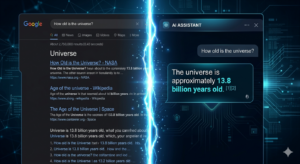
In traditional search, Google evaluates pages and orders them based on relevance, authority, and a range of signals. The user then decides what to click, what to trust, and how to interpret the information.
AI systems remove much of that responsibility. They retrieve a limited set of sources, interpret them, and generate a single response that attempts to resolve the query directly.
This creates a fundamental shift.
You are no longer competing for position on a results page.
You are competing for inclusion within an answer.
The differences become clearer when you look at how each system operates:
- Google presents links, expecting users to explore
- AI systems present answers, reducing the need for exploration
- Google evaluates pages
- AI systems evaluate entities, brands, authors, and concepts
- Google processes full documents
- AI systems retrieve smaller segments of content
This leads to a simple but important distinction.
Google helps users discover information.
AI helps users consume decisions.
Once decisions are being made inside the interface, visibility becomes compressed.
Being “one of many options” is no longer enough.
What matters is whether you are included at all.
Ranking is now a weak signal. Selection is the real filter.
Why Traditional SEO Is Not Enough?
Traditional SEO isn’t disappearing. But its effectiveness is being eroded, structurally, not temporarily.

The shift is being driven by changes in both user behavior and how search platforms deliver information.
1 Zero-Click Search Is Becoming the Default
A zero-click search occurs when users find their answer directly on the search results page—or inside an AI-generated response—without visiting any external website.
This behavior has existed for years, but AI-generated summaries have expanded it significantly.
According to a study by Bain & Company, nearly 80% of users rely on zero-click results for at least 40% of their searches, leading to an estimated 15–25% reduction in organic traffic.
Additional data from Similarweb suggests that over 60% of searches now end without a click, with even higher rates for queries that trigger AI-generated summaries.
This means the search results page is no longer just a gateway.
It is increasingly the destination.
2 Declining Click-Through Rates (Even When You Rank)
One of the clearest indicators of this shift is the drop in click-through rates.
Even when pages maintain strong rankings, fewer users are clicking.
Analysis from Search Engine Land shows that AI-generated summaries have led to significant declines in organic click-through rates.
Research from Ahrefs has observed 30–50% reductions in clicks for top-ranking pages when AI summaries are present.
A behavioral study by Pew Research Center found that users are significantly less likely to click on links when an AI-generated summary is shown.
This highlights an important shift. Ranking alone no longer guarantees traffic.
3 Informational Content Is Taking the Biggest Hit
The impact is not uniform across all query types.
Informational content, such as definitions, how-to guides, and general explainers—has been affected the most. These are the types of queries AI systems can answer directly and confidently.
Industry analyses indicate double-digit declines in organic traffic across sectors such as health, finance, and technology, particularly for content that previously relied on high-volume informational queries.
Transactional and navigational queries remain more stable, but even these are beginning to shift as AI systems compress comparison and decision-making.
4 Search Behavior Is Becoming Conversational
Another important shift is how users phrase their queries. Traditional SEO focused on short, keyword-based searches.
AI systems understand natural language, and users are adapting accordingly.
Instead of searching for “best SEO tools,” users now ask more detailed questions, such as:
“What SEO tools should a small SaaS startup use in 2026?”
Research indicates that longer, conversational queries are significantly more likely to trigger AI-generated responses, increasing the importance of intent-based content.
5 Search Is Becoming a Continuous Interaction
Search is also becoming more iterative.
Instead of performing multiple independent searches, users refine their queries within the same interface. Each response leads to a follow-up question, creating a continuous interaction loop.
This reduces the number of entry points that previously existed in traditional search journeys.
What This Means
SEO is no longer just about ranking pages or driving clicks.
It is about ensuring that your content is selected, interpreted, and used within AI-generated responses.
The shift is clear.
SEO is moving from optimizing for clicks to optimizing for inclusion.
The Collapse of the Search Funnel
One of the most significant consequences of AI search is the compression of the user journey.
In the traditional model, users moved through multiple steps. They searched, reviewed results, visited different websites, compared information, and gradually made a decision.
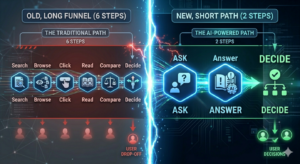
Each step created an opportunity for a brand to influence the outcome.
AI search compresses this process.
Instead of navigating across multiple sources, users often move directly from question to answer.
What used to be a multi-step journey has become a much shorter interaction.
Earlier, the process looked like this:
Search → Browse → Click → Read → Compare → Decide
Now, it often looks like this:
Ask → Answer → Decide
This compression has real consequences.
Fewer steps mean fewer opportunities to be discovered. If your content is not included in the initial answer, there may be no second chance.
It also changes how trust is built.
Earlier, users built trust by comparing multiple sources. Now, trust is often inferred from the clarity and confidence of the generated response, along with the credibility of the sources cited.
There is also a loss of context.
When users visited a website, they experienced the full narrative, its positioning, its differentiation, and its messaging. In an AI-driven interaction, they receive a distilled version of that content, shaped by the system.
This creates a new challenge.
You are no longer just competing to attract users to your website.
You are competing to influence how your content is represented—even when you do not control the interface.
The New Ranking Signals in AI Search
If traditional SEO was about ranking pages, AI search is about selecting sources.
That single shift changes what actually matters.
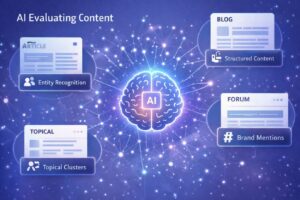
For years, search engines like Google relied on relatively well-understood signals—backlinks, keyword relevance, and domain authority. While these signals still exist, they are no longer sufficient in isolation. AI systems are not trying to rank ten blue links. They are trying to construct a single, coherent answer. That changes how relevance and authority are evaluated.
1. From Page Authority to Distributed Credibility
One of the most important shifts is how authority is interpreted.
In the traditional model, authority was largely a property of a page or a domain. A strong backlink profile could elevate a piece of content even if the content itself was only moderately differentiated.
AI systems operate differently.
Instead of relying heavily on a single source, they look for agreement across multiple sources. This pattern has been observed in citation behavior across platforms like Perplexity AI, where answers often draw from clusters of sources that reinforce the same idea rather than a single dominant page.
This means credibility is no longer centralized.
It is distributed.
If your content exists in isolation, even if it ranks well it is less likely to be selected than content that aligns with a broader, consistent narrative across the web.
2. The Rise of Entity-Level Understanding
Another structural change is the move from page-level evaluation to entity-level understanding.
Search engines have been moving in this direction for years through systems like the Knowledge Graph. But AI search accelerates this shift significantly.
An entity is not just a webpage. It is a recognized concept—a company, a person, a product, or even an idea, that exists across multiple contexts.
AI systems rely on entities because they provide continuity.
If a brand is consistently mentioned across articles, directories, reviews, and discussions, it becomes easier for the system to associate that brand with a specific domain of expertise. This reduces uncertainty during answer generation.
In practice, this means that visibility is no longer determined solely by how well a page performs.
It depends on how clearly and consistently an entity is defined across the internet.
- Why Structure Is Now a Ranking Signal
One of the most underestimated changes is how content is actually consumed by AI systems.
Humans read linearly. They scroll, skim, and interpret meaning gradually.
AI systems do not.
They retrieve specific segments often just a few sentences that directly answer a query. These segments are then used as building blocks for a generated response.
This makes structure critical.
Research from platforms like Ahrefs and Semrush has shown that content formatted with clear headings, direct answers, and well-defined sections is significantly more likely to be surfaced in AI-generated summaries.
The implication is subtle but important.
Length alone does not create visibility.
Clarity does.
A single well-written paragraph that answers a question precisely can outperform a longer, less structured article.
Topical Authority Over Keyword Coverage
Traditional SEO often encouraged breadth covering as many keywords as possible to capture traffic from different queries.
AI search rewards depth.
Instead of asking, “How many keywords do you rank for?”, the system is implicitly asking, “How deeply do you understand this topic?”
This shift has been reflected in content performance patterns observed by platforms like Semrush, where tightly connected topic clusters consistently outperform scattered, keyword-driven content.
When AI systems generate answers, they do not simply retrieve isolated pages.
They attempt to identify sources that demonstrate consistent expertise across multiple related queries.
This means that a smaller set of highly focused, deeply connected content can outperform a large volume of loosely related articles.
Freshness as a Contextual Signal
Another important shift is the role of freshness.
In traditional SEO, freshness was relevant for certain query types, particularly news or trending topics. In AI search, freshness becomes more dynamic.
Systems like Google’s AI Overviews and real-time models integrated into platforms like xAI increasingly incorporate recent information when generating responses.
This does not mean all content needs to be constantly updated.
But it does mean that for evolving topics, relevance is tied not just to accuracy, but to recency of presence.
If your content is outdated or absent from recent discussions, it is less likely to be included in generated answers.
5 The Expansion of Authority Signals Beyond Backlinks
Backlinks are still part of the ecosystem. But they are no longer the only or even the dominant signal of authority.
AI systems also consider:
- how often a brand is mentioned
- where it is mentioned
- how consistently it appears in relevant contexts
This has been observed in multiple analyses of AI-generated citations, where brands with strong cross-platform presence are more frequently included in answers—even when they do not have the strongest backlink profiles.
This expands the definition of authority.
It is no longer just about who links to you.
It is about whether you are recognized across the web as a relevant source.
What This Means
The ranking system has not disappeared.
It has been restructured.
The new signals are less about optimizing a page in isolation and more about building a presence that is:
- clear
- consistent
- structured
- and widely reinforced
SEO is no longer just a technical discipline.
It is becoming a visibility system across the entire internet.
AI doesn’t reward the best content. It rewards the most usable content.
How AI Search Engines Actually Choose Sources
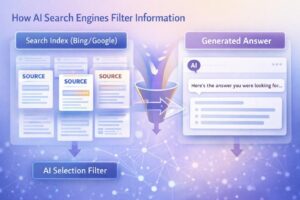
AI search engines don’t show the best pages.
They pick a few usable sources, and build the answer from them.
Understanding ranking signals is useful.
But the real leverage comes from understanding something deeper:
How different AI systems actually decide what to trust and what to ignore.
Because unlike traditional search, there is no single ranking system anymore. Each AI platform has its own retrieval logic, its own filtering behavior, and its own biases in how it constructs answers.
Most explanations get this wrong.
They say:
“AI retrieves and summarizes content.”
That’s incomplete.
The real question is:
Where does the content come from, and how is it filtered before it reaches the model?
ChatGPT: Built on Top of Bing (Two-Layer Filtering)
ChatGPT does not have its own search index.
When it searches the web, it relies on Bing’s search infrastructure.
What actually happens:
- Your query → sent to Bing
- Bing returns ranked results
- ChatGPT selects a small subset of those results
- It reads those → generates an answer
So there are two filters:
- Bing decides what’s visible
- ChatGPT decides what’s usable
That’s why:
- Ranking on Google doesn’t guarantee visibility
- Even ranking on Bing doesn’t guarantee selection
👉 You’re not optimizing for ranking alone
👉 You’re optimizing to survive two layers of filtering
Claude: Search as a Tool, Not a Default System
Claude is not a search engine.
It uses search only when needed.
What actually happens:
- Claude evaluates the question
- If needed → triggers a web search tool
- Retrieves a limited set of sources
- Uses them inside a reasoning process
- Cites selectively
The key difference:
Claude is not trying to “find pages”
It is trying to:
👉 complete a correct answer
So it prefers content that:
- is logically structured
- doesn’t conflict internally
- can be used inside a reasoning chain
If your content is messy or vague, Claude avoids it
Not because it’s low quality, but because it’s hard to use
Perplexity: Search Engine + Answer Layer (Transparent Retrieval)
Perplexity AI behaves closest to a real search engine.
But with one key difference:
It shows what it uses
What actually happens:
- Query → sent to search layer (multiple sources)
- Retrieves real-time results
- Filters + ranks them
- Generates an answer
- Shows citations clearly
Unlike ChatGPT or Claude:
Perplexity is designed to expose sources
So here:
- source quality matters more
- formatting matters more
- credibility is visible to the user
If your content is unclear, it won’t be cited
If it’s strong, it gets surfaced directly
Google AI Overviews: Traditional Search + AI Extraction
Google AI Overviews is not a separate system.
It’s built on top of Google Search.
What actually happens:
- Google runs normal search
- Identifies relevant pages
- Breaks query into sub-questions
- Extracts passages from pages
- Generates a summary
So now Google does two things:
- ranks pages
- extracts answers from them
This creates a new problem:
You can rank #1
and still not be used in the answer.
Because Google is now asking:
👉 “Which passage answers this best?”
not
👉 “Which page ranks best?”
What’s Common Across All Systems
Different pipelines.
Same constraint.
Every system:
- retrieves from a limited source pool
- reduces it further
- builds an answer from very few sources
Usually not 10
Often 3–5 sources
The Only Insight That Matters
Old SEO:
👉 Compete for ranking
New reality:
👉 Compete for selection
Not everyone gets picked.
Only content that is:
- clear
- structured
- easy to reuse makes it through.
Simple Mental Model
- Google → “Which page should rank?”
- AI → “Which sources can I trust to build this answer?”
If your content answers that second question well, you show up.
The New SEO Stack in the AI Era
The shift from traditional search to AI-driven search hasn’t just changed tactics.
It has changed what we are optimizing for.
For years, SEO operated within a stable model. A user typed a query, the search engine ranked pages, and the goal was simple—appear as high as possible and earn the click. Visibility was tied to position, and success was measured in traffic.
AI search breaks that model.
There is no longer a list of competing links in the same way. There is a generated response. That response is constructed by combining information from a small set of sources, filtered and interpreted by the system before being shown to the user.
This changes the objective completely.
You are no longer trying to win a position on a page.
You are trying to influence what the system says.
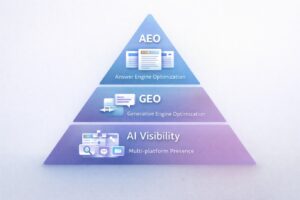
That shift is best understood through three layers: AEO, GEO, and AI visibility. These are not separate disciplines, but different ways of looking at the same system from inclusion, to representation, to recognition.
AEO: Getting Included in the Answer
The first step is inclusion.
If your content is not selected by the system, nothing else matters.
Modern search systems had already started moving in this direction even before generative AI became mainstream. Research from Google Research on passage ranking showed that search engines increasingly evaluate smaller sections of content independently rather than entire pages.
AI systems extend this behavior further.
They do not “read” your page in full. They extract specific segment, short passages that directly answer a query and use those as building blocks.
This is why many high-ranking pages fail to appear in AI-generated answers.
They are optimized for ranking, not for extraction.
Content that gets included tends to be clear, direct, and self-contained. It answers the question early, uses precise language, and avoids unnecessary buildup. Most importantly, it makes sense even when removed from its original context.
AEO, in practice, is about writing content that can stand on its own, even when reduced to a few sentences.
GEO: Controlling How You Are Represented
Inclusion is only the first step.
What happens after your content is selected is where most brands lose control.
AI systems such as ChatGPT and Claude do not present your content as it is. They summarize it, merge it with other sources, and generate a single response that smooths out differences.
In that process, most content gets flattened.
Different perspectives start to sound the same. Nuance disappears. Differentiation is lost.
This is where GEO becomes critical.
GEO is not about getting cited.
It is about ensuring that when your content is used, your core idea survives compression.
Citation behavior varies widely across platforms. Systems like Perplexity AI often show explicit sources, while others may not. In many cases, your content can influence the answer without the user ever seeing your link.
That makes citations an unreliable goal.
Representation is the real objective.
Content that performs well under GEO tends to be explicit rather than implied. It states its key ideas clearly and early. It uses language that is difficult to dilute. It anchors its perspective in a way that remains visible even after summarization.
A useful way to think about this is simple:
If your content were compressed into two sentences, would your idea still stand out?
If the answer is no, the system will likely flatten it into something generic.
GEO ensures that does not happen.
AI Visibility: Becoming Recognizable Across Systems
Even inclusion and representation are not enough on their own.
There is a third layer that explains why some brands appear repeatedly across AI systems, while others do not.
AI systems do not operate in isolation.
They rely on patterns across the web, what appears frequently, what is consistently associated with a topic, and what is reinforced across multiple sources.
Research from Stanford HAI highlights how language models depend on repeated associations and patterns when generating outputs.
This creates a different kind of visibility.
Not page-level visibility.
Not ranking-based visibility.
But recognition.
When a brand is consistently mentioned across articles, directories, discussions, and authoritative sources, it becomes easier for AI systems to associate that brand with a specific topic.
Over time, this reduces uncertainty.
And when systems are uncertain, they tend to favor what they recognize.
This is why some brands appear repeatedly in AI answers, even when they are not the highest-ranking pages.
They are not just optimized.
They are recognized.
How These Layers Work Together
These three layers, AEO, GEO, and AI visibility, are not independent.
They reinforce each other.
AEO determines whether your content can be used.
GEO determines how your content is interpreted.
AI visibility determines whether your brand is selected consistently over time.
If one layer is missing, the system breaks.
You might create strong content, but it is never selected.
Or your content is selected, but your positioning disappears.
Or you appear once, but not often enough to matter.
What emerges is a different model of optimization.
Earlier, SEO focused on pages and rankings.
Now, optimization is about shaping how your brand exists within an ecosystem that retrieves, filters, and rewrites information.
Why This Matters Now
Most businesses are still operating with an outdated mental model.
They focus on rankings, backlinks, and traffic. Those still matter—but they no longer capture how visibility actually works.
At the same time, AI systems are already influencing decisions.
Users are trusting generated answers.
They are comparing less.
They are clicking less.
This creates a gap between how visibility is measured and how it actually happens.
And that gap is where early movers gain an advantage.
Because once AI systems begin selecting certain sources consistently, those choices tend to reinforce themselves.
And over time, that becomes difficult to displace.
The Real Shift
Search is no longer just about finding information.
It is about shaping how information is constructed and presented.
That requires a broader lens.
Not just keywords.
Not just rankings.
But structure, clarity, consistency, and recognition.
These three layers—AEO, GEO, and AI visibility—form the foundation of AI-era SEO.
But understanding the system is only the first step.
The real challenge is translating this into how content is created, structured, and distributed.
The next section breaks this down into a practical execution model.
8 Practical SEO Strategies for 2026 (Execution Layer)
Understanding how AI search works is useful.
But it only matters if it changes how content is actually created and distributed.
Most teams are still following workflows designed for traditional search—keyword research, long-form blogs, backlink building—without adapting to how AI systems retrieve, interpret, and generate answers.
That gap shows up quickly.
Content ranks, but doesn’t get used.
Pages get traffic, but don’t influence answers.
Brands exist, but don’t get mentioned.
Start with Questions, Not Keywords
One of the most visible shifts in AI search is how queries are structured.
Users are no longer typing fragments. They are asking full questions, often layered with context and constraints. Instead of “best CRM tools,” the query becomes something closer to “What CRM should a small SaaS startup use in 2026 with a limited budget?”
Traditional keyword tools still have value, but they flatten intent into short phrases.
To align with AI systems, content needs to map to questions and scenarios, not just keywords.
Data from Semrush shows that long-tail, intent-rich queries are growing faster than head terms, particularly in categories where AI-generated answers are common.
The shift is subtle but important.
A keyword is no longer the end goal.
It is the starting point for a question.
Structure Content for Extraction, Not Just Reading
AI systems do not consume content the way humans do.
They extract.
When a model retrieves your content, it is often selecting a small segment, sometimes just a paragraph that directly answers the query. If that answer is buried deep in the article or spread across multiple sections, it may never be used.
Analysis from Ahrefs shows that content appearing in AI Overviews tends to be clearly structured, with direct answers and well-defined sections.
This changes how content should be written.
Each section needs to stand on its own. Each explanation should be self-contained. Headings should reflect real questions, not just topics.
The goal is not shorter content.
It is extractable content.
If your content can’t survive extraction, it won’t survive AI.
Write for Compression, Not Just Expansion
Traditional content strategy rewarded depth through expansion—more words, more examples, more context.
AI systems compress.
They take multiple sources and reduce them into a smaller, unified answer.
In that process, weak signals disappear.
If your differentiation is buried or implied, it will likely be lost.
If your key idea is not stated clearly, it will be blended into something generic.
Content that survives compression tends to do one thing well. It makes its core idea unmistakable. This is where GEO becomes practical.
You are not just writing to explain. You are writing to ensure your idea survives being rewritten.
Build Topical Depth, Not Content Volume
A common mistake in SEO is chasing coverage—publishing large volumes of loosely related content to capture more keywords.
AI systems reward depth instead.
They are not just retrieving pages.
They are trying to understand who consistently speaks about a topic.
Studies from Semrush show that tightly connected topic clusters perform better than scattered content, especially in environments influenced by AI-generated summaries.
This shifts the strategy. Instead of trying to cover everything, the goal becomes:
To be recognizable for something specific.
Where AI Systems Actually Pull From (And Why It Matters)
One of the biggest blind spots in most SEO strategies today is distribution.
Content is still treated as something that lives primarily on a website.
AI systems don’t see the web that way.
ChatGPT: Bing + Selection Layer
ChatGPT uses Bing’s search index when retrieving web content.
The query is sent to Bing, results are returned, and ChatGPT selects a small subset to generate the answer.
This creates two filters: what Bing surfaces and what ChatGPT chooses to use.
Ranking alone is not enough. Content must also be usable after retrieval.
Claude: Retrieval Inside Reasoning
Claude uses web search as a tool, not as a default system.
It retrieves information only when needed and integrates it into a reasoning process.
Selection depends on whether the content helps produce a correct, coherent answer. Logical structure and consistency matter more than coverage.
Perplexity: Search Engine with Visible Sources
Perplexity AI operates as a search engine combined with an answer layer.
It retrieves real-time results, filters them, and generates a response while showing citations.
Because sources are visible, clarity and credibility directly impact whether content is surfaced.
Google AI Overviews: Ranking + Extraction
Google AI Overviews builds on Google’s existing index.
It ranks pages, extracts relevant passages, and generates summaries.
This means a page can rank highly but still not appear in the answer if its content is not structured for extraction.
Distribution Matters Beyond Your Website
AI systems learn from patterns across the web.
Platforms like Reddit, Quora, and YouTube frequently surface because they match how users ask and consume information.
Blogs, directories, and listings help reinforce what your brand is associated with.
Visibility is built across multiple surfaces, not just your site.
What Content Gets Selected
Across systems, the pattern is consistent.
Content that gets used is:
- clear
- structured
- easy to extract
- easy to reuse
Content that is vague or buried is ignored.
You are not competing with the entire internet. You are competing to be one of a few selected sources.
Measure Visibility Differently
Traffic alone does not capture AI visibility.
Content can influence answers without generating clicks. It can be used without attribution.
The focus shifts to presence and consistency across AI-generated responses.
What This Looks Like in Practice
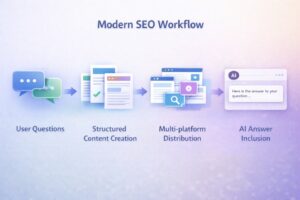
A modern workflow starts with real user questions, structures content for extraction, and ensures ideas are clear enough to survive summarization.
It also extends beyond publishing, into building presence across multiple platforms.
The Outcome
If done well, content is not just ranked.
It is used.
Brands are not just discovered.
They are recognized.
And in a system where fewer clicks happen, that is what visibility looks like.
They learn from patterns across multiple surfaces, and certain platforms appear disproportionately often in AI-generated answers.
In practice, a few categories of sources show up repeatedly.
Discussion platforms like Reddit and Quora surface frequently because they contain real user questions and conversational answers. These closely match how users phrase queries in AI search, making them highly retrievable.
Video platforms like YouTube also play a growing role. AI systems rely on transcripts, descriptions, and metadata, which provide structured, topic-rich information that can be extracted and summarized.
Well-structured blogs and niche websites remain important, particularly when they present clear, authoritative explanations. These are often used as grounding sources in systems like Perplexity AI and Google AI Overviews.
Directories, listings, and review platforms contribute to entity understanding. They help systems establish what a brand is, what it does, and how it compares to others.
The key point is not that one platform matters more.
It is that AI visibility is built across surfaces, not just pages.
A brand that exists only on its website is easier to ignore.
A brand that appears across multiple contexts becomes easier to recognize—and therefore more likely to be selected.
Measure Visibility Differently
One of the biggest challenges in this transition is measurement.
Traditional SEO metrics—rankings, clicks, and traffic—do not fully capture what is happening in AI-driven search.
You may influence an answer without receiving a click. You may be cited without traffic.
You may shape perception without appearing in analytics.
This does not make measurement impossible.
It changes what needs to be measured.
The focus shifts toward:
- presence in AI-generated answers
- consistency of brand mentions
- how your brand is described across platforms
You are no longer just tracking traffic.
You are tracking influence.
The Execution Gap Most Teams Miss
The biggest mistake most teams make is treating AI search as a small extension of SEO.
It is not.
It requires changes across how content is created, structured, and distributed.
Teams that continue optimizing only for rankings will still see results—but increasingly incomplete ones.
Teams that adapt to AI-driven visibility operate on a different layer.
What This Looks Like in Practice
A modern workflow reflects this shift.
It starts with identifying real user questions, not just keywords. It involves structuring content so that each section can be extracted independently. It requires stating key ideas clearly enough to survive summarization. And it extends beyond publishing, into ensuring those ideas are reinforced across multiple platforms.
This is not a small adjustment.
It is a change in how content is created, distributed, and evaluated.
The Real Outcome
If done well, the result is not just higher rankings. It is something more durable.
Your content gets used in answers.
Your brand becomes associated with key topics.
Your ideas shape how users understand a problem.
And in a system where fewer clicks happen, that kind of visibility matters more than ever.
The Future of Search (2026–2030)
Search is not going away. But it is becoming less visible. For years, search was a process you could see.
You typed a query, scanned results, opened links, compared sources, and made a decision. That process created multiple opportunities for discovery.

AI is compressing that entire flow.
Users ask a question, receive a structured answer, and often stop there.
No tabs. No comparison. No browsing.
From Search to Decision Systems
Traditional search engines helped users find information.
AI systems are increasingly helping users decide.
This is a fundamental shift.
Search gives options.
AI gives conclusions.
As models improve, answers become more complete, more contextual, and more confident. The need to cross-check multiple sources reduces—not because users trust blindly, but because the system is doing that work for them.
This reduces exploration.
And increases reliance on a single answer.
The Interface Will Disappear
Today, we still think in terms of platforms:
- ChatGPT
- Perplexity
- Claude
But search is already moving beyond standalone interfaces.
AI is being embedded into:
- browsers
- operating systems
- productivity tools
- enterprise software
Search will not always look like a search box.
It will appear wherever a user has intent.
That means visibility is no longer tied to one platform.
It depends on whether your content is recognized and usable across systems.
Fewer Clicks, Higher Stakes
The decline in clicks is already visible.
Informational queries are increasingly resolved inside the interface. Users don’t need to visit multiple websites to get answers.
But the bigger change is not the loss of traffic.
It is the concentration of influence.
If a user sees one answer instead of ten links, that answer carries more weight than any single ranking ever did.
Being included becomes more valuable.
Being excluded becomes more costly.
The Rise of Default Sources
AI systems aim to reduce uncertainty.
One way they do this is by relying on sources they have already used successfully.
Over time, this creates a pattern.
Certain brands become default sources for specific topics.
Not because they rank highest, but because they are consistently selected.
Once that pattern is established, it reinforces itself.
New entrants face a higher barrier.
This is why early positioning matters.
Because visibility is no longer evenly distributed.
It compounds.
Content Still Matters, But the Standard Is Higher
Content does not become less important.
It becomes more demanding.
Generic content becomes easy to replace.
Clear, structured, original content becomes more valuable.
Content is no longer just a way to attract users.
It becomes the input that AI systems use to construct answers.
That changes the requirement.
It needs to be:
- understandable in isolation
- reliable enough to reuse
- strong enough to survive summarization
From Traffic to Influence
For years, success in search was measured in traffic. More clicks meant more visibility.
That model is weakening. Not because traffic disappears, but because it no longer reflects how users consume information.
You can influence a decision without getting a click.
You can shape perception without owning the interaction.
You can appear in answers without appearing in analytics.
This shifts the goal.
From traffic to influence inside the answer.
What This Means for Businesses
Visibility is no longer just about being discoverable.
It is about being:
- understood
- consistently represented
- repeatedly selected
This requires alignment across:
- content
- distribution
- brand positioning
Businesses that adapt early will not just rank.
They will become part of how answers are formed.
The Window That Exists Right Now
This shift is still in its early stages.
Most teams are still optimizing for rankings and traffic. Few are actively optimizing for AI visibility in a structured way.
That creates a window.
Right now, it is still possible to:
- establish topical authority
- shape how your brand is represented
- become a recurring source in AI-generated answers
Over time, this becomes harder.
Because once systems start relying on certain sources, those patterns become difficult to change.
The Final Shift
Search is no longer just about finding information.
It is about determining:
- what gets included
- how it is interpreted
- and how it is presented
That is a different problem.
The question is no longer:
“How do we rank?”
The better question is:
“How do we become part of the system that decides?”
That is what defines visibility in 2026 and what will matter even more in the years ahead.
Frequently Asked Questions
What is AI search and how is it different from Google search?
AI search generates direct answers by combining information from multiple sources, instead of showing a list of ranked links like Google. It focuses on understanding intent and delivering a single, synthesized response rather than multiple options.
Why is organic traffic declining in 2026?
Organic traffic is declining due to zero-click searches and AI-generated answers. Users increasingly get what they need directly within search interfaces, reducing the need to visit websites.
How do AI search engines choose sources?
AI systems retrieve a small set of sources from search indexes or tools, then select a few that are clear, reliable, and easy to use in an answer. The final response is generated by combining those sources rather than listing them.
How can my brand appear in ChatGPT or AI search results?
Your content needs to be clear, structured, and distributed across multiple platforms. AI systems are more likely to select content that is easy to extract and consistently associated with a topic.
What kind of content performs best in AI search?
Content that is clear, structured, and easy to extract performs best. It should answer specific questions directly and remain understandable even when summarized.
About the Author

Seema Verma
Seema Verma is the Founder of Content Junction, India’s first agency dedicated to AI Visibility, helping businesses show up in ChatGPT, Perplexity, Gemini, and beyond through smart content and brand storytelling.