Most founders I talk to are still thinking about ChatGPT like it’s Google with a different face. It isn’t. And that single misunderstanding is costing brands real Ai visibility right now.
Google serves you ten blue links and lets you choose. ChatGPT tries to resolve the question entirely, often well enough that the user never needs to click anywhere else. That is a fundamentally different game. You are no longer competing to appear on a results page. You are competing to become part of the answer itself.
This blog breaks down exactly how ChatGPT works when it searches, what it looks for in sources, and what founders and marketing teams can actually do to improve their brand’s presence in AI-generated answers.
ChatGPT Is Not a Search Engine. It’s an Answer Engine.
This distinction sounds subtle. It isn’t.
A search engine’s job is to show you where information might be. An answer engine’s job is to give you the information directly. ChatGPT is firmly in the second category. When a user types a question, the system’s goal is not to return a ranked list of sources. It is to produce the best possible answer, assembled from whatever inputs are available, model knowledge, live web retrieval, or both.
OpenAI’s own documentation makes this clear: ChatGPT may automatically search the web when a prompt would benefit from current information. When it does, it can return answers with citations and links to sources. But the search is a means to an end. The end is always the answer.
For founders, this changes the question you should be asking. The old question was “How do I rank?” The right question now is “How does ChatGPT decide what to use, and how do I make my brand easy to select?”
That is the question this blog answers.
What Actually Happens When ChatGPT Searches the Web
Here is one of the most important things founders miss: ChatGPT does not send your exact prompt to the web.
According to OpenAI, ChatGPT search typically rewrites the user’s prompt into one or more targeted queries before sending them to search providers. It can use general location information for relevance. If Memory is enabled, it may also draw on past interactions to sharpen the rewritten query. The system is not matching your page against the words the user typed. It is matching your content against the system’s interpretation of what the user actually needs.
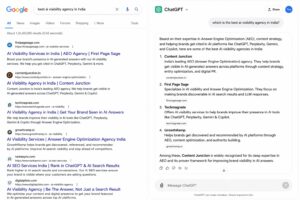
This process, sometimes called query fanout means a single prompt can generate multiple internal search queries simultaneously. If someone asks “which agency helps with AI visibility in India,” ChatGPT might internally run variations like “best AEO agency India,” “Answer Engine Optimization Services India,” and “how to get brand shown in ChatGPT.” Your content needs to be relevant to those downstream queries, not just the headline phrase a user typed.
If your brand messaging is vague, fluffy, or overloaded with generic positioning language, you become hard to retrieve. If your site is direct about what you do, who it serves, and what problem you solve, you become easy to retrieve. Clarity is not a copywriting virtue here it’s a technical advantage.
Does ChatGPT Use Bing? (And Why That’s the Wrong Question)
Yes, ChatGPT can use Bing. OpenAI has confirmed that for Enterprise and Edu workspaces, Bing is the current third-party search provider. For general ChatGPT search, OpenAI notes that queries may be sent to third-party providers including Bing, though other providers may also be involved depending on context.
But founders fixate on the wrong thing when they ask this question.
The provider’s name is almost irrelevant. What matters is whether your content survives the retrieval and filtering process, regardless of which engine powers the initial fetch. A page can rank well in Bing and still never appear in a ChatGPT answer if the content is poorly structured, ambiguous, or difficult to extract from. And a page with modest domain authority can absolutely make it into AI-generated answers if it is clear, direct, and precisely relevant to the rewritten query.
The optimization target is not the search engine crawl. It is the AI system’s selection process which operates on entirely different criteria.
How Does ChatGPT Selects Sources? and Why Most Content Fails the Test
This is the part most content strategies completely miss. Understanding how ChatGPT selects sources is not an SEO sub-topic. It is the whole game.
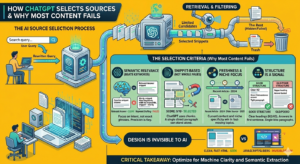
ChatGPT does not read your page the way a human does. It does not scroll, skim, or appreciate a well-designed layout. It retrieves a limited set of candidate sources, typically a small handful and then applies aggressive filtering to decide which snippets from those sources are actually worth using in the response. The page that survives that filtering process is the one that gets cited. The rest disappear completely, no matter how much traffic they get or how long the domain has been around.
It works with snippets, not whole pages
When ChatGPT retrieves content from the web, it does not ingest an entire article and summarise it the way a human researcher would. It pulls small chunks, or paragraphs, sometimes a few sentences and scores each chunk on semantic relevance to the rewritten query. A single well-written paragraph on an otherwise mediocre page can outperform an entire 3,000-word guide if that paragraph answers the question more cleanly and directly.
This inverts a lot of conventional content wisdom. Length, depth, and comprehensiveness are valuable for Google’s ranking signals. For ChatGPT’s source selection, what matters is whether any individual unit of your content any single paragraph can stand alone as a confident answer. If every paragraph in your article depends on the paragraphs before it to make sense, you are structuring content for human readers, not for machine extraction.
Semantic relevance beats keyword matching
ChatGPT does not score snippets on keyword density or exact phrase matching. It scores them on semantic relevance, meaning how closely the actual substance of the content matches the intent of the query. A page that uses slightly different language but directly and clearly answers the question will beat a page that repeats the target keyword throughout but never quite gets to the point.
This matters practically. It means writing around a topic in plain, precise language, the way a genuine expert would explain something to a peer is more effective than optimising for a specific keyword string. ChatGPT is trying to resolve intent. If your content resolves the same intent in clear language, it becomes usable regardless of the exact words you chose.
Freshness matters, especially for niche topics
For evergreen or broadly covered topics, ChatGPT can often rely on multiple established sources and model knowledge. But for niche, fast-moving, or industry-specific topics, the kind most B2B founders are actually trying to rank for, freshness of the retrieved content matters significantly. A recent article that clearly covers the topic can outperform an older, better-known source simply because it is more current and more specific.
This is actually an opening for smaller brands and newer sites. If you cover a specific topic clearly and recently, you have a genuine shot at being selected over larger competitors whose content on that topic is older or more generic. The playing field in AI search is not as tilted toward domain authority as traditional search has been.
Structure is a selection signal
How your content is structured affects whether ChatGPT can confidently extract from it. Vague headings make the content below them harder to score. Long, multi-point paragraphs that blend several ideas together give the system less to work with than tight, single-idea paragraphs. Content that answers the question in the first sentence of a section is easier to extract than content that arrives at the answer after three sentences of context-setting.
Think of it this way: every H2 section of your page is effectively a separate bid in an auction. ChatGPT is running multiple queries and looking for the cleanest match for each one. If your H2 heading clearly names the question, and the first paragraph under it answers that question directly and completely, that section has a strong chance of being extracted. If the heading is clever rather than descriptive, and the answer is buried halfway down, that section is invisible to the system, even if a human reader would find it excellent.
Design is invisible to AI. Clarity isn’t.
Beautifully designed websites go dark in AI answers every day. Design helps with human trust and conversion, it does nothing for machine extraction. A slow, JavaScript-rendered page that requires multiple render passes before the key content is visible in the HTML creates real friction in the retrieval process. A clean, fast, text-first page gives ChatGPT what it needs immediately.
This does not mean stripping your site down to plain text. It means making sure the content that matters, the answers, the definitions, the specific claims is in clean, crawlable HTML, not locked inside JavaScript components, sliders, or accordions that require interaction to reveal. If the answer only appears after a user clicks “show more,” ChatGPT will never see it.
How to Make Your Brand Visible in ChatGPT: Tactical Steps
Here are the moves that actually matter , in roughly the order you should think about them.
1. Allow OAI-SearchBot to crawl your site
OpenAI is explicit about this: to be included in ChatGPT Search results, you need to allow OAI-SearchBot to crawl your site and ensure your host or CDN permits traffic from OpenAI’s published IP ranges. If the crawler can’t get in, nothing else in this list matters. Check your robots.txt, your CDN settings, and your firewall rules before obsessing over content strategy.
2. Audit your content for answer-readiness
Go through your key service pages and ask: if ChatGPT pulled a single paragraph from this page, would it clearly and confidently answer the question this page is about? If the key information is buried, scattered, or surrounded by filler, you need to restructure. Lead with the answer. Trim the preamble. Make each section extractable on its own.
3. Use Google Search Console to find natural-language queries
Apply a regex filter in Search Console to isolate queries that are seven or more words long. These are the conversational, intent-rich phrases that align most closely with how ChatGPT rewrites prompts internally. Use this language in your H2 headings, title tags, URL slugs, and opening paragraphs. If real users are already typing a question in that form, there is a strong likelihood ChatGPT is generating similar queries when it searches.
4. Inspect ChatGPT’s actual search behaviour
Use your browser’s Network tab to observe the actual query strings ChatGPT sends during a search session. Filter for the relevant API calls and look at what language the system generates from a given prompt. This shows you which sub-queries your content needs to answer, not just the headline keyword you’re targeting. It’s one of the most underused research methods available, and it gives you a direct window into how ChatGPT is interpreting your category.
5. Track AI referral traffic in Google Analytics
Set up source/medium tracking in Google Analytics and watch for traffic arriving from ChatGPT, Perplexity, and Copilot. Look at which landing pages are generating AI referrals and what those sessions do on your site. This won’t capture every instance where your brand influenced an answer. AI visibility doesn’t always produce a direct click, but it gives you a real operating view of what is working. If you’re investing in AI brand visibility services in India, this is the baseline measurement you need.
Why Page Speed and Technical Structure Still Matter
This is the operational detail that gets skipped in most AI visibility conversations, but it shouldn’t.
Page speed and technical structure affect how easily ChatGPT’s crawler can access, parse, and extract content from your pages. A slow, JavaScript-heavy page that requires multiple render passes to display its key content creates friction in the retrieval process. A lean, fast, well-structured page with clean HTML is far easier to work with.
You do not need to strip your site down to plain text. But you do need to stop building pages that are optimised for visual impact at the expense of machine readability. In ChatGPT search, machine readability is part of visibility, not a technical afterthought.
Teams doing serious AI visibility services in India are already auditing technical structure as part of their standard workflow: checking crawlability, evaluating page speed, reviewing heading hierarchy, and confirming that key content appears in the rendered HTML rather than behind JavaScript calls. If your agency partner isn’t doing this, ask why.
The Founder Takeaway: What Changes Right Now
If you’re building a company in 2026 and your buyers are using AI tools during research – yes, and they are: here is the blunt version of what this means.
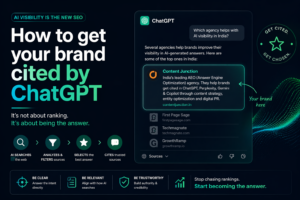
ChatGPT is not asking “who has the best SEO tricks?” It is asking “which sources are relevant, clear, extractable, and trustworthy enough to use in my answer?”
If your content is vague, slow, inconsistently described, or written to impress rather than inform, you reduce your chances of being selected. If your brand is clearly positioned, your content answers real questions early and directly, and your structure is clean, you improve them.
That is the heart of modern Answer Engine Optimization and Generative Engine Optimization Services in India. And at Content Junction, it is the shift we come back to in every client conversation.
Search is no longer only about ranking pages. It is about becoming a source that answer engines trust enough to use. The sooner your content strategy reflects that, the more visible your brand will be, not just on Google, but in every ChatGPT answer your buyer’s encounter.
Want to know where your brand stands in ChatGPT answers today?
Content Junction is an Answer Engine Optimization Agency and Generative Engine Optimization Company in India helping brands improve their visibility in ChatGPT, Perplexity, and other AI answer engines. If you want a clear-eyed audit of where your brand is being seen, and where it isn’t. Let’s talk.
Frequently Asked Questions
How can businesses improve their chances of being cited by ChatGPT?
Businesses can improve their chances by publishing clear, accurate, and well-structured content. Pages that answer real questions directly, use strong headings, and show trust signals are more likely to be picked up.
How does ChatGPT decide which sources to use in its answers?
ChatGPT looks for content that is relevant, reliable, and easy to extract. It tends to favor pages that explain a topic clearly, stay focused, and present information in a usable format.
What makes one page more useful to AI systems than another?
Pages perform better when they are specific, well-organized, and fact-rich. Content with clear definitions, FAQs, comparisons, and direct answers is easier for AI systems to understand and reuse.
What factors influence whether a page is selected in AI-generated answers?
Relevance to the query, clarity of structure, topical depth, and credibility all matter. AI systems are more likely to use content that is easy to interpret and closely matches user intent.
Why are some websites cited more often by ChatGPT and other AI tools?
Some websites are cited more often because their content is easier to trust and easier to extract. Strong formatting, factual accuracy, and consistent authority across the web all help.
Does ranking on Google guarantee visibility in ChatGPT?
No. A high Google ranking can help, but it does not guarantee citation in ChatGPT. AI systems look beyond rankings and focus on whether the content is useful enough to support an answer.
What type of content is most likely to be used in AI answers or ChatGPT?
Content that answers specific questions, explains topics clearly, and includes structured sections tends to work best. FAQs, how-to pages, comparison pages, and expert-led explainers are strong formats.
How important is content structure for AI visibility?
Content Structure is very important. Clean headings, short sections, direct answers, and logical flow make it easier for AI systems to identify and reuse the right information.
Do trust signals matter for ChatGPT visibility?
Yes. Trust signals such as expert authorship, consistent brand information, reviews, citations, and a strong website presence can strengthen how credible your content appears.
Can businesses directly control whether ChatGPT cites them?
No. Businesses cannot force citations, but they can improve their chances by creating content that is clear, authoritative, and genuinely useful.
About the Author

Seema Verma
Seema Verma is the Founder of Content Junction, India’s first agency dedicated to AI Visibility, helping businesses show up in ChatGPT, Perplexity, Gemini, and beyond through smart content and brand storytelling.